As an Amazon Associate I earn from qualifying purchases. Read our affiliate disclosure.
“Wood beadboard” describes a family of panels and boards, not one standardized product. A bead describes the visible face profile; tongue-and-groove describes how adjoining edges connect. One product can have both. If you are comparing wood beadboard or beadboard tongue and groove for a wall, verify the species, grade, net face width, thickness, length, finish options, and installation conditions on the exact listing and guide.
Quick answer: Do not choose by species name alone. First decide the face profile and joint you want, then compare the exact board’s net coverage, grade, dimensions, and manufacturer instructions for acclimation, humidity, movement, and use. The sources reviewed here do not support a universal ranking of pine species or brands.
Affiliate disclosure: As an Amazon Associate, we may earn from qualifying purchases. This Amazon search for wood beadboard and tongue-and-groove paneling is a search, not a verified listing, price, availability, or fit recommendation.
On this page
- Bead profile versus tongue-and-groove joint
- What the wood listing should specify
- Why installation conditions matter
- A practical product-comparison checklist
- Frequently asked questions
Bead profile versus tongue-and-groove joint
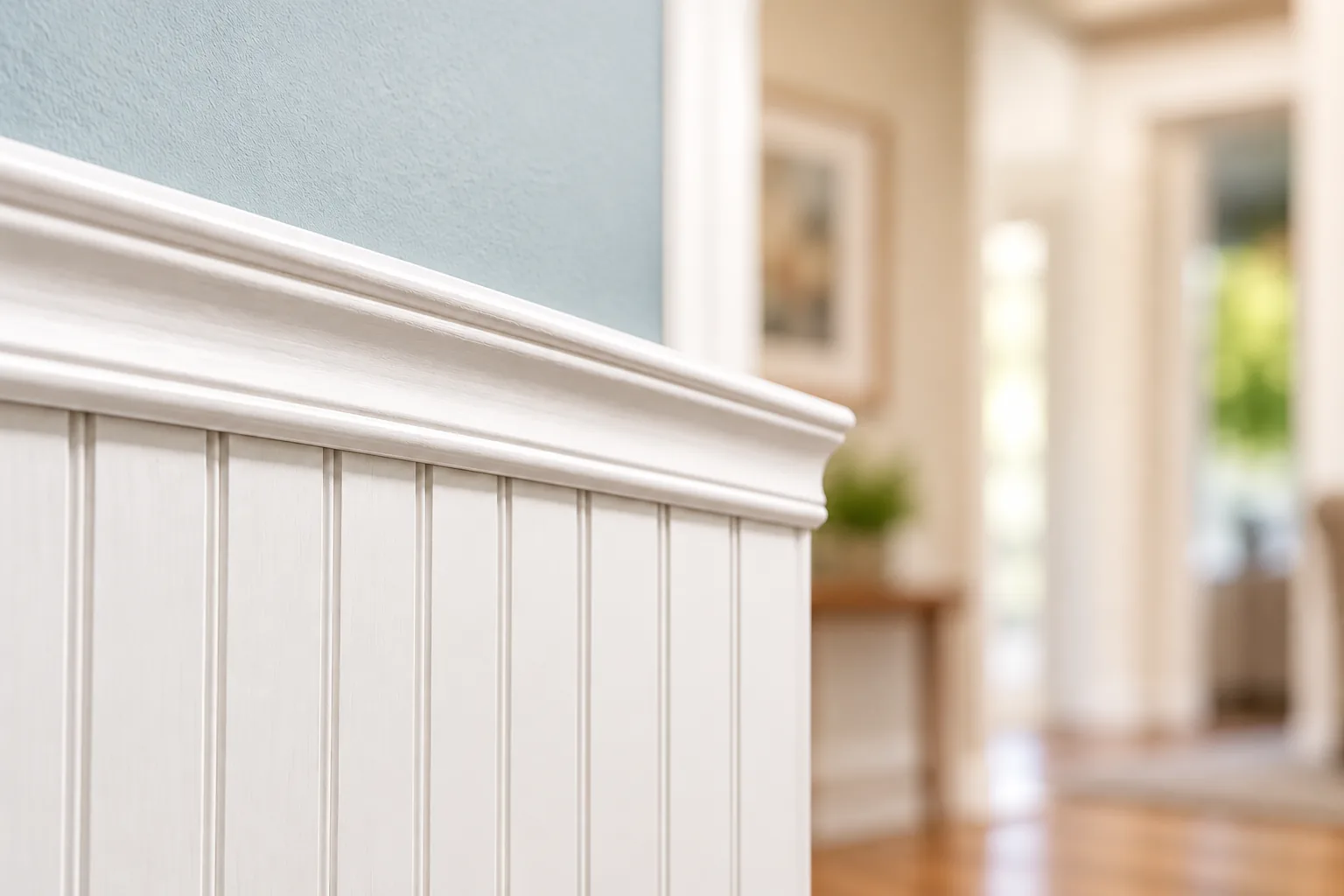
The bead is the visible ridge or shadow line across the face. Tongue-and-groove is an edge arrangement in which a projecting tongue meets a matching groove. These terms describe different features, so they can appear together. Nantucket Beadboard describes its Standard Bead as a modern interpretation of a traditional pattern created by tongue-and-groove paneling; Russin’s catalog also lists tongue-and-groove pine beadboard with an edge-and-center bead. That supports the distinction for those examples, but it is not a universal industry definition. See Nantucket’s profile description and Russin’s pine paneling catalog.
When comparing photos, check whether the product is a panel, individual plank, or preassembled wainscot piece. A close-up of the face may show the bead but hide the edge joint. Ask for a profile drawing or specification if the joint affects the installation plan.
What the wood listing should specify
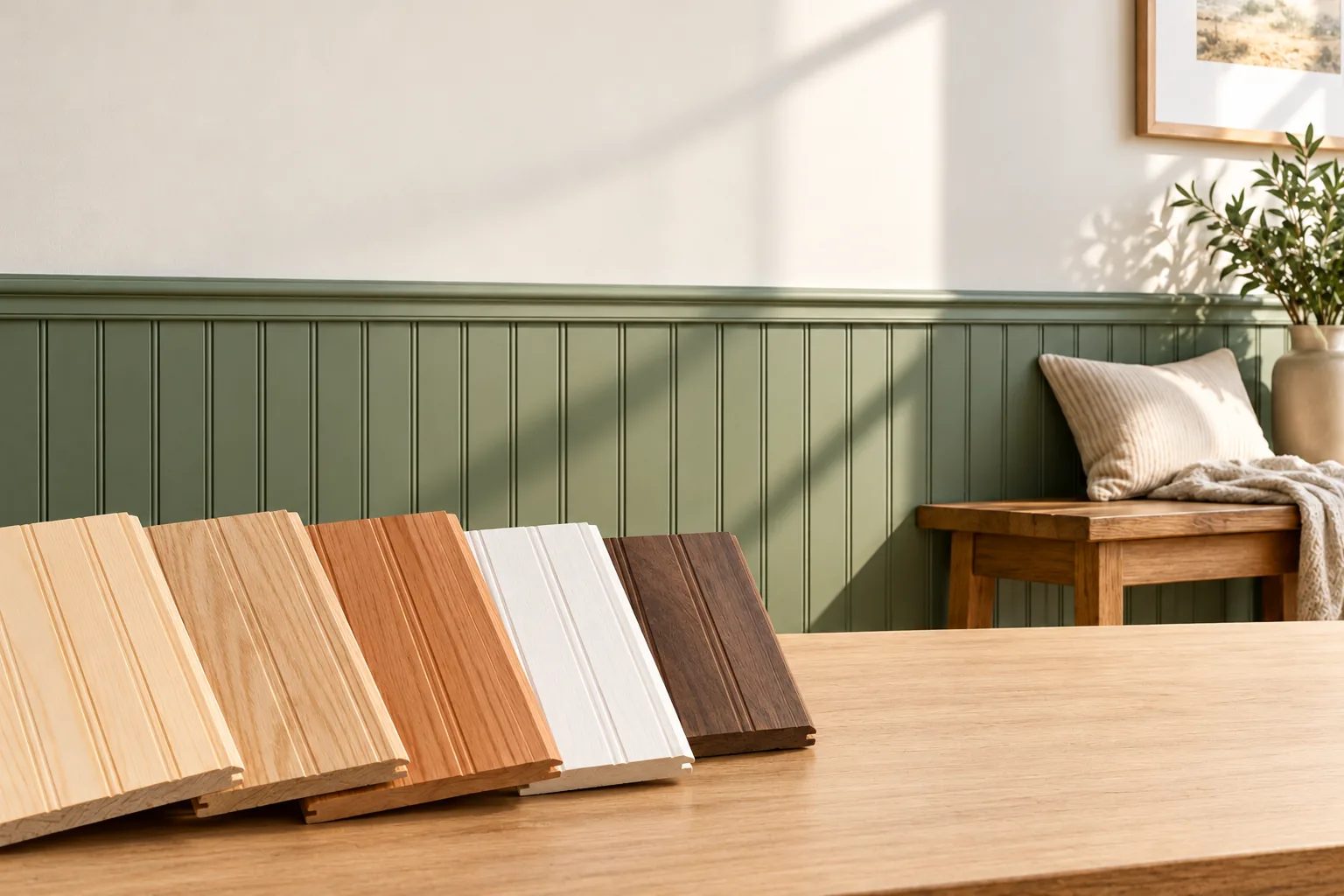
“Pine” is not enough to calculate coverage or predict the finished appearance. Russin’s captured catalog includes both Eastern White Pine and Ponderosa Pine, and distinguishes knotty and clearer grades. One example lists a 3/4-inch by 5 1/2-inch net size, while other products vary by profile, grade, thickness, and available length. These are catalog examples, not a complete species comparison or a claim that one pine is better.
A retailer’s House of Fara Model 32P listing describes its item as knotty pine tongue-and-groove wainscot paneling and says it can be clear-coated, stained, or painted. That statement belongs to that particular product; it should not be copied to another pine panel without checking its finish guidance. See the specific Model 32P listing.
Use this comparison table when reading a listing:
| Listing detail | Why it matters | What to verify |
|---|---|---|
| Species and grade | Identifies the stated wood and appearance grade | Exact product spec; do not assume knotty, clear, or proprietary grades are equivalent across sellers |
| Net face width | Determines visible coverage after the joint engages | Net coverage, not just nominal width |
| Thickness and length | Affect fit, joint detail, handling, and cut plan | Exact dimensions and available lengths for the SKU |
| Face profile | Determines bead spacing and visual pattern | Profile drawing and whether the board has one or more bead faces |
| Edge/end match | Affects how boards join and whether ends interlock | Manufacturer’s installation details and any required backing at end joints |
| Finish compatibility | Determines which coating options the supplier supports | Written finish instructions for that exact product |
Why installation conditions matter
Solid wood changes dimension as moisture conditions change. The practical takeaway is not one universal acclimation period; it is to follow the exact manufacturer’s range and process. Johnson Pine says its own installation area should remain at 35%–55% relative humidity and 60–80°F during acclimation, installation, and afterward, and warns that movement can appear as gapping, cupping, or checking. Those are Johnson Pine’s conditions, not an all-wood standard. See Johnson Pine’s installation and care instructions.
Ready Pine’s instructions call for 7–10 days of acclimatization in the room and say some expansion or contraction is expected. The same guide describes its product as suitable for interior applications, porch ceilings, and soffits, but not vertical siding. Those limits belong to Ready Pine. See the Ready Pine installation instructions.
Other product guides give different instructions. Nantucket’s sheet products use an average 48–72-hour acclimation period, with support spacing that varies by panel thickness; its instructions state that its 1/4-inch product is not recommended for horizontal applications. These are sheet-panel directions and should not be substituted for solid-pine plank instructions. For exterior beadboard ceilings and soffits, WindsorONE specifies conditions for its product, including moisture-content limits, sheathing and housewrap, ventilation, staggered joints, and not caulking or gluing tongue-and-groove joints. Consult Nantucket’s instructions or WindsorONE’s exterior guidance only when considering those products.
This is why a wood beadboard label cannot answer whether a product belongs in a bathroom, on a porch ceiling, or outdoors. The room, exposure, substrate, finish, ventilation, and exact product all matter. If the chosen guide does not cover the intended location, request written manufacturer guidance before purchase or installation.
A practical product-comparison checklist
Before ordering, save the listing and current instructions, then record:
- Product name, SKU, species, and grade.
- Net face width, thickness, available lengths, and actual package coverage.
- Face profile, edge joint, and whether end joints require backing.
- Intended application: interior wall, ceiling, porch ceiling, soffit, or other use explicitly documented.
- Acclimation time and environmental conditions, including temperature and humidity if specified.
- Fasteners, adhesive, support spacing, movement gaps, ventilation, and substrate requirements.
- Approved primers, stains, paints, or clear finishes for that exact product.
A quick Amazon search may help you compare search-result wording, but use manufacturer documents to verify dimensions and installation. Do not infer a product’s species, grade, moisture tolerance, or compatibility from a thumbnail or search snippet.
Frequently asked questions
Is tongue-and-groove the same thing as beadboard?
Not exactly. Tongue-and-groove describes an edge joint; beadboard describes a face pattern. A board can be tongue-and-groove and have a bead profile at the same time. Confirm the exact face and edge details from the product description or profile drawing before planning coverage and fastening.
Which pine species is best for beadboard?
The available evidence here does not support a universal best species. Supplier catalogs show different pine species, grades, dimensions, and profiles, but they do not form a controlled comparison. Choose based on the exact appearance, dimensions, finish instructions, availability, and installation documentation for the product you are considering.
Can wood beadboard be used on a porch ceiling?
Some named products document porch-ceiling or soffit applications, while others have different limits. Check the exact installation guide for exposure, framing, ventilation, moisture, fasteners, and finish. Do not treat a general “wood beadboard” label or another manufacturer’s instructions as approval for the product you have.
Conclusion
Wood beadboard comparisons become clearer when you separate the visible bead profile from the edge joint, then verify species, grade, net dimensions, and finish instructions for the exact SKU. Treat acclimation, humidity, and allowed-use guidance as product-specific. Choose the product only after its own documentation fits the room and installation plan.
Sources: Manufacturer and retailer documents are linked where their claims appear. The examples are not a complete market survey, and no product was hands-on tested for this article.