As an Amazon Associate I earn from qualifying purchases. Read our affiliate disclosure.
The right beadboard cap molding is the one whose actual profile and notch fit the installed panel—not simply the piece labeled “chair rail” or “top cap.” Suppliers use overlapping names, and product dimensions do not always tell you what panel thickness the molding accepts. Measure the panel and verify compatibility with the exact profile before ordering.
Quick answer: Record the installed panel thickness, look for a documented notch or a named compatible system, and compare the full profile drawing with your wall and adjacent casing. A cap’s overall width and height are not proof that its groove fits your panel.
Affiliate disclosure: As an Amazon Associate, we may earn from qualifying purchases. This Amazon search for beadboard cap molding returns search results only; confirm profile and fit with the manufacturer before buying.
On this page
- What “cap,” “top cap,” and “chair rail” mean
- Measure the panel and compare profiles
- Product examples: dimensions are not interchangeable
- Fit and installation checklist
- Frequently asked questions
What “cap,” “top cap,” and “chair rail” mean
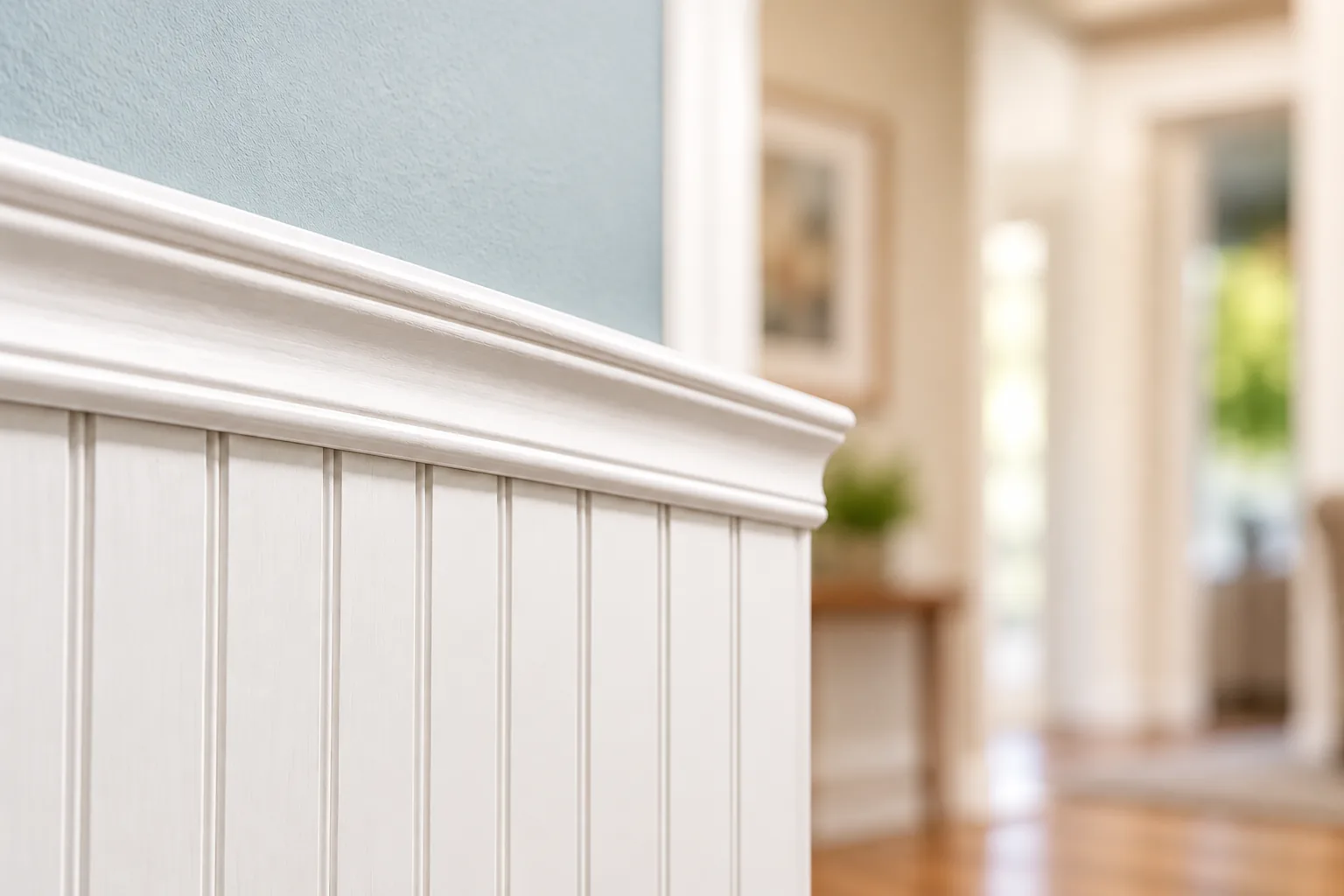
A cap molding finishes the exposed upper edge of a wainscot panel. A supplier may call a similar finishing profile a top cap, wainscot cap, or chair rail, and one product name can combine terms. American Beadboard’s product title, for example, calls its piece a “Top Cap / Chair Rail.” This naming variation means the label alone does not establish profile, projection, notch, or panel compatibility.
Think in cross-section: the panel thickness must fit the molding’s receiving notch or overlap as intended, while the molding’s height and projection determine how it meets the wall and nearby casing. Compare the manufacturer’s drawing and instructions, not just the product name or one outside dimension.
Measure the panel and compare profiles
Measure the panel after installation if possible, including any adhesive or substrate condition that changes how far its top edge sits from the wall. Then look for explicit product language such as “made for” a named panel thickness, “notched to fit” a stated range, or a system specification that pairs the cap with a panel. If the listing provides only overall molding dimensions, treat compatibility as unconfirmed and ask the seller.
| Candidate profile | Captured specification | What the specification proves—and does not prove |
|---|---|---|
| American Beadboard poplar top cap | Made for its 5/8-inch premium beadboard; 1 1/16 inches thick by 2 1/2 inches tall | Supports that named panel system; do not assume fit on another 5/8-inch panel without checking profile. Product page |
| New England Classic system cap | 1 1/2 by 1 1/4 inches by 96 inches, paired in its system specification with 3/8-inch panels | A system example; follow that supplier’s compatibility recommendations. Specification |
| Vintage Woodworks 54-261 cap | 1 1/8 by 1 3/4 inches; notched for 3/8-, 1/2-, or 5/8-inch material | The stated thickness range applies to this exact profile. Cap molding page |
| Vintage Woodworks 54-210 wainscot cap | 11/16 by 2 inches; notch stated for 3/8- to 3/4-inch wainscoting | A different named profile and fit range; do not transfer it to other styles. Wainscot cap page |
| Kuiken Brothers KB805 | 11/16 by 1 5/8 inches overall in the captured profile listing | Overall size is shown, but the captured text does not specify matching beadboard thickness. Profile listing |
This table illustrates why dimensions alone can mislead. Two caps may have similar overall sizes but different notches, back profiles, or intended panel systems. Likewise, the fact that a category page calls an item a wainscot cap does not establish beadboard fit. The captured Lowe’s category includes multiple materials and a PVC listing, while Kuiken Brothers lists beadboard cap SKUs by profile dimensions; neither category label replaces a product-specific fit statement.
Fit and installation checklist
Before buying, confirm the complete assembly:
- Panel: exact SKU, installed thickness, substrate, and top-edge position.
- Cap: profile drawing, notch size or explicitly compatible system, material, finish, and stock length.
- Projection: whether the cap clears the bead pattern and meets adjacent casing cleanly.
- Corners and returns: whether inside/outside corners, end returns, or splices need separate pieces.
- Fastening: product-specific adhesive or nail guidance and whether the cap hides panel fasteners.
- Quantity: wall run, corner deductions, splice locations, and cut waste based on the actual sold length.
American Beadboard’s installation guide says to place each panel fastener through the lap joint near the top so it will be covered by the top cap. That is the supplier’s procedure for its system, not a universal fastening rule. Review its beadboard and molding installation guide together with the instructions for the panel you selected.
For a visual check, place a short sample of the cap against the actual panel and wall if the supplier offers samples. Confirm the notch engages without forcing or leaving an unintended gap, and inspect how the cap meets casing at a window or door. If you cannot test a sample, request a profile drawing with both the panel thickness and cap notch labeled.
Frequently asked questions
Is beadboard cap molding the same as chair rail?
The terms can overlap in supplier catalogs, but the name alone does not prove that two profiles have the same shape or panel fit. Compare the actual cross-section, notch, projection, height, and manufacturer’s compatibility statement with your installed panel.
Will any cap molding fit 3/8-inch beadboard?
No. A specific New England Classic system cap is paired with its 3/8-inch panels, and one Vintage Woodworks profile states a broader thickness range. Other profiles may publish only overall dimensions. Verify the exact cap and panel pairing rather than treating a nominal thickness as universal compatibility.
How do I know whether a molding notch fits?
Measure the installed panel and compare that measurement with the manufacturer’s stated notch range or compatible system. If the documentation gives only overall dimensions, ask for a profile drawing or sample. Do not infer notch size from the molding’s height or width.
Conclusion
Choose beadboard cap molding by its cross-section, documented panel fit, and how it finishes the wall—not by a generic label. Record the panel thickness, verify the notch and profile, and check corners, casing, lengths, and fastening instructions before ordering. If the exact fit is not documented, get supplier confirmation for the specific panel and molding SKUs.
Sources: The manufacturer profile and installation documents are linked alongside the product-specific examples. Current stock and pricing were not checked.